
Where voyage estimation sits in chartering
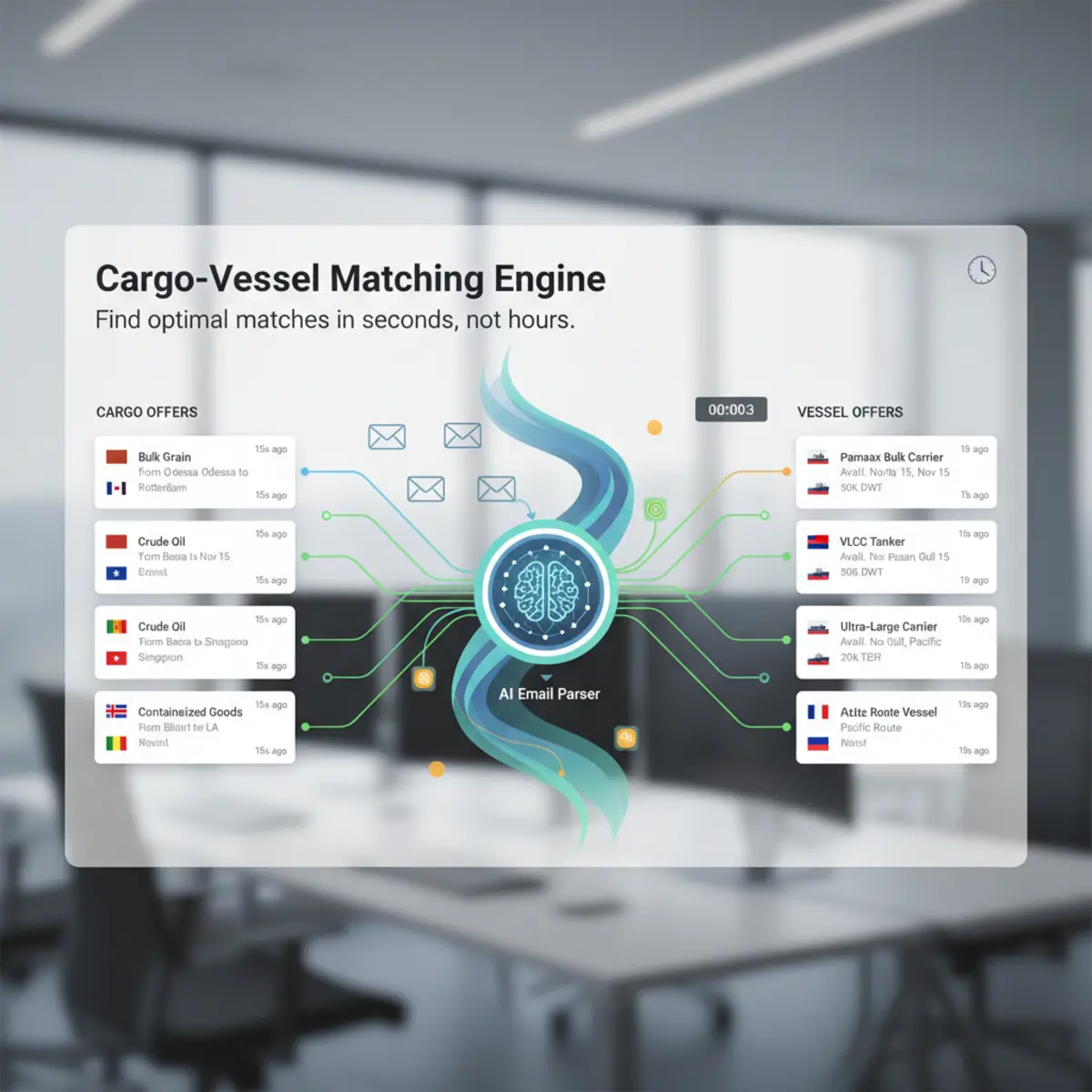
Voyage estimation begins after a team has a cargo-vessel combination worth testing. The estimator converts operational and commercial assumptions into duration, cost and earnings scenarios. LaycanMatch operates earlier: it parses incoming offers, organizes cargo and vessel records and ranks possible pairs. A reviewed shortlist can reduce re-keying into the dedicated estimator, but it does not replace that calculation.
Required estimation inputs
Input group | Typical inputs | Control question
Route | Load and discharge ports, distance, canals and alternatives | Is the distance source and route version visible? Vessel performance | Laden and ballast speed, consumption, capacity and restrictions | Are assumptions tied to the correct vessel and condition? Bunkers | Fuel grades, prices, quantities and ROB assumptions | Can price and consumption scenarios be compared? Port and canal | Port costs, canal dues, agency and other call expenses | Are omissions visible rather than silently zero?
Cargo and freight | Quantity, freight basis, commissions, terms and time | Are units and freight terms explicit? Time | Sea days, port days, weather and waiting assumptions | Can each time component be reviewed?
Core outputs to evaluate
Output | Why it matters | Review requirement
Voyage result | Summarizes revenue less voyage costs | Show currency, basis and included cost categories
TCE | Compares earnings over voyage time | Expose the exact formula and time assumptions
Duration | Separates sea, port, canal and waiting time | Keep component assumptions visible
Bunker consumption and cost | Connects speed and consumption to price | Retain fuel grade, price date and scenario
Port and canal cost | Captures route-specific expenses | Identify source, currency and update date
Sensitivities | Tests speed, price, time, quantity and freight changes | Compare named scenarios without overwriting the base case
Evaluation checklist
Assumptions :: Every key value has an owner, source, unit and updated time. Versions :: Users can preserve a base case and compare scenarios without losing prior assumptions. Audit trail :: Changes identify who changed what and when. Permissions :: Sensitive rates and cost inputs are available only to appropriate users. Exports and handoff :: Reviewed scenarios can be shared in the formats used by the team.
Integrations :: Any claimed data connection is verified for coverage, refresh frequency, units and failure behavior.
Common failure modes
Stale bunker prices can make a clean-looking result commercially misleading. Wrong units can multiply quantity or consumption errors. Hidden speed and weather assumptions make TCE difficult to challenge. Missing port or canal costs can overstate earnings. Rounding too early can distort comparisons. A credible estimator exposes these assumptions and makes omissions reviewable instead of producing an unexplained single number.

How matching prepares estimation inputs
Stage | Input | Output | System boundary
Offer intake | Broker email or circular | Cargo or vessel record | LaycanMatch where supported
Matching | Structured cargo and vessel records | Ranked shortlist | LaycanMatch where supported
Voyage estimation | Distance, speed, costs, consumption and freight | Voyage result, TCE and scenarios | Dedicated estimator
Fixture | Negotiated terms and approvals | Recap and fixture record | Fixture management workflow
Spreadsheet versus dedicated voyage software
A spreadsheet can be transparent and flexible when one experienced owner controls assumptions, units and formulas. It becomes fragile when versions multiply, sources are unclear or changes are exchanged by attachment. Dedicated software can improve consistency, scenario comparison, permissions and auditability, but only when the team verifies the formulas, data sources and workflow fit. The correct choice depends on voyage volume, team size, calculation complexity and governance needs.
A practical selection process
Start with representative voyages, not a polished vendor demo. Recreate one simple voyage, one canal route, one voyage with multiple cost currencies and one scenario with incomplete data. Compare every input and output with the team’s accepted calculation. Record gaps, data-source dependencies and manual steps. Confirm how a reviewed cargo-vessel shortlist enters the estimator and how the chosen scenario leaves it for negotiation or fixture work.
Editorial boundary
This guide describes software evaluation and operational controls, not financial, legal or charter-party advice. Formulas, data sources and commercial assumptions must be validated by qualified users. LaycanMatch does not claim to calculate TCE, bunker consumption, port costs, canal dues or voyage results.
Validate units, currencies and time bases
A credible evaluation uses deliberately awkward cases. Mix metric tonnes and long tons, daily and total costs, several currencies, different bunker grades and rates quoted on different bases. Check whether the software rejects incompatible units, shows conversion sources and dates, and prevents a blank cost from silently becoming zero. Inspect whether commissions, port time, weather allowance and waiting time enter the calculation once and only once.
These controls matter more than an attractive headline result because small hidden assumptions can materially change a voyage comparison.
Scenario governance for a chartering team
Name scenarios by the changed assumption, such as lower speed, higher bunker price or additional waiting day. Preserve the accepted base case, show the author and timestamp, and make differences visible without comparing separate attachments. Confirm who may edit vessel performance, commercial rates and cost tables. Test whether an approved scenario can be locked or duplicated for further work.
If the estimator imports structured cargo or vessel data, verify exactly which fields transfer and require a user to confirm them before calculation.
Questions to ask a voyage-estimation vendor
Ask who owns distance, port-cost and bunker-price sources; how frequently each source updates; what happens when a feed fails; whether users can override data; and whether overrides are clearly marked. Request the formula for every reported earnings metric and reproduce it independently. Confirm currencies, rounding, daylight and time-zone treatment, canal alternatives, ballast legs and multi-port voyages. Ask for export formats, API boundaries, permissions, retention and change history.
A reliable answer should be specific enough for an experienced operator to verify.
Handoff from matching to estimation
The practical handoff begins with a reviewed cargo and vessel candidate. Transfer the ports, dates, cargo quantity, vessel identity and relevant source remarks, but do not assume these are sufficient for an estimate. Add vessel performance, route distance, bunkers, port costs, canal costs, freight basis, commissions and expected time from approved sources. Keep a link or reference back to the broker communication so a changed quantity or laycan can be traced.
LaycanMatch supports the shortlist and source review stage; the estimator remains responsible for calculations.
Model ballast and laden legs separately
A voyage estimate should distinguish the ballast leg to the load port from the laden leg to discharge. Each leg may use a different distance, speed, weather allowance and consumption profile. The vessel’s open position determines the ballast starting point, while route restrictions can change both distance and time. Record whether distance comes from a routing service, an approved company table or manual entry, and keep the source date. Do not hide an assumed zero-ballast case.
If the open position changes, create a new scenario or version so the original commercial comparison remains reproducible.
Speed, consumption and bunker-price assumptions
Use vessel-specific ballast and laden speeds, daily consumption by fuel grade, auxiliary consumption at sea and in port, and any relevant idle or working-port profile. State whether figures are warranted, historical or provisional. Bunker prices need grade, location, currency, unit, source and effective date. Include expected remaining-on-board quantities and bunkering costs only when the workflow supports them.
Scenario testing should show the effect of slower laden speed, higher consumption or a changed bunker price without overwriting the accepted base case.
Port, canal, weather and waiting-time inputs
Port costs should identify load and discharge ports, agency or tariff source, currency and included services. Canal and strait dues belong only to the selected route. Add estimated time for arrival formalities, loading, discharge, shifting, congestion, weather and other expected waiting where the commercial model requires it. Laytime and demurrage concepts must not be reduced to an unexplained generic port-days value.
When a cost or duration is unknown, flag it and test a range rather than entering a silent zero that makes the voyage appear stronger.
Freight, commissions and TCE calculation overview
A typical estimate combines freight revenue with voyage expenses and total voyage duration before deriving a daily earnings measure such as TCE. The exact formula depends on freight basis, cargo quantity, commissions, address commission, brokerage, port and canal costs, bunkers, hire treatment and the organization’s accounting policy. Software should expose each component, unit and currency conversion rather than showing only a final daily figure.
This guide explains the evaluation logic; LaycanMatch does not calculate TCE, freight revenue or voyage expenses.
Worked input sheet for a controlled test
Input group | Example test value | Review question
Cargo and freight | 42,000 mt wheat; freight basis supplied by evaluator | Is tolerance and commission treatment explicit?
Ballast leg | Varna open to Constanta; approved route distance | Can the source and route version be inspected?
Laden leg | Constanta to Alexandria; separate laden speed | Are canal or route alternatives isolated by scenario?
Vessel performance | Ballast and laden speed; sea and port consumption by grade | Are units and provenance visible?
Bunkers | Price by grade, port, currency and effective date | Does a price change preserve the base case?
Ports and time | Load/discharge costs, days, waiting and weather allowances | Do missing items raise a visible warning?
Output control | Duration, expenses, revenue basis and daily earnings result | Can another user reproduce the result from the saved assumptions?
Common calculation mistakes to reproduce during evaluation
Test mixed tonnes and long tons, nautical miles entered as kilometres, duplicated commissions, bunker prices in the wrong currency, canal dues retained after a route change, port time counted twice and ballast consumption omitted. Also test a missing port cost and a negative or implausible speed. Good software should reject, warn or clearly expose these cases.
A spreadsheet can produce a correct answer, but only disciplined formula ownership, locked references, version naming and peer review prevent an old assumption from surviving unnoticed.
Spreadsheet versus dedicated estimation software
A spreadsheet may suit a low-volume desk when formulas are controlled, inputs have named owners and scenario files are consistently versioned. Dedicated software becomes more valuable when several users compare voyages, approved vessel profiles and cost sources must be reused, permissions differ, and every changed assumption needs history. Evaluate both options with the same representative voyages.
Compare setup time, error visibility, reproducibility, access control, scenario comparison and export quality rather than choosing solely by interface appearance.
Worked evaluation scenario
Take a hypothetical grain cargo from Constanta to Alexandria and a suitable dry-bulk vessel open in the Black Sea. First confirm cargo quantity, tolerance, laycan, load and discharge terms and the vessel identity from source communications. Then enter route distance, ballast and laden speed, consumption by fuel grade, bunker prices, port costs, canal costs if applicable, commissions, freight basis and expected port time into the estimator. Save this as a base case.
Create separate scenarios for one additional waiting day, a higher bunker price and a lower laden speed. The software should show which assumption changed and how duration, cost and earnings outputs respond, without overwriting the base case.
Acceptance test matrix
Test case | Expected behavior | Failure signal
Missing port cost | Warn or leave the cost visibly unresolved | Silent zero improves the result
Mixed currency cost | Convert from a named rate and date or require conversion | Unlabeled arithmetic
Changed bunker price | Preserve the base case and show the delta | Base assumptions overwritten
Canal alternative | Keep route and dues tied to the selected scenario | Canal cost retained on the wrong route
Edited vessel speed | Identify editor, time and affected outputs | Result changes without history
Exported result | Include units, currency, scenario and assumption date | Standalone number without context
Implementation and ownership checklist
Assign ownership for vessel performance, bunker prices, port costs, route assumptions and commercial inputs before rollout. Decide which values may come from external sources and which require manual approval. Define review thresholds for stale prices and incomplete costs. Agree naming and retention for scenarios, permissions for rates and commissions, and the export used in negotiation or approval.
Train users to challenge unexpected outputs by tracing them to assumptions rather than adjusting values until a desired result appears. Schedule periodic comparison with an independently accepted calculation.
What a product demonstration should prove
Ask the vendor to build the same voyage from a blank screen using your supplied assumptions. Introduce a missing value and observe whether the system warns, blocks or silently substitutes. Change one unit and one currency. Duplicate the scenario, alter speed and bunker price, and compare differences. Inspect history and permissions. Export the result and ask another user to reproduce it.
Finally, demonstrate the handoff from a structured cargo-vessel candidate without implying that email extraction supplied every input required by the estimator.
Record the evaluation result
Document accepted gaps, required controls, data dependencies and the owner of each follow-up before purchase. A repeatable written result makes later vendor comparison more reliable.