The Anatomy of Unstructured Maritime Circulars
Daily chartering workflows across dry bulk and tanker sectors depend heavily on email circulars broadcast by shipbrokers, owners, and charterers. These messages aggregate open vessel positions, prompt tonnage, cargo orders, and regional market quotes into dense, freeform text.
Unlike standardized electronic data interchange formats, maritime circulars exhibit extreme syntactic diversity. A single email may contain multiple vessel positions spread across different geographic basins, brief commodity descriptions with mixed metric and imperial units, informal laycan ranges, and non-standard port abbreviations.
Without structured extraction, chartering teams must manually read, verify, and transcribe incoming data into internal sheets or local records. This manual intake creates operational latency, increases data-entry errors, and obscures matching opportunities when circular volume surges.
Core Vessel Parameters in Position Circulars
Extracting vessel positions accurately requires capturing identity, physical dimensions, cargo-handling gear, and geographical availability.
Vessel Identification: The vessel name and IMO number serve as foundational identifiers. Capturing the IMO number eliminates ambiguity caused by common vessel names, recent renamings, or typographical mistakes. Year of build, flag state, and classification society must also be recorded, as charterers routinely apply strict age and vetting criteria.
Capacity and Dimensional Constraints: Key parameters include deadweight tonnage (DWT), summer draft, gross tonnage (GT), length overall (LOA), beam, and cubic capacity (grain and bale). For geared tonnage, crane count, safe working load (SWL), outreach, and grab specifications must be isolated to verify terminal compatibility.
Temporal Availability and Open Location: Open date windows and open port or delivery ranges indicate when and where the ship becomes commercially available. Circulars often express dates using relative language (such as prompt, spot, or mid-month windows), which must be resolved into explicit calendar ranges.

Key Cargo Parameters in Order Circulars
Cargo circulars present operational requirements that determine vessel suitability, stowage requirements, and voyage economics.
Commodity and Volume: Capturing the specific commodity grade, total quantity, and quantity tolerance (such as percentage more or less in owner's option) is fundamental. Volume must be recorded alongside stowage factor estimates and any cargo-specific handling requirements, such as moisture limits, hazardous classifications, or fumigation needs.
Routing and Port Terms: Load and discharge ports, berth restrictions, safe port warranties, and geographical ranges define the itinerary. Circulars frequently specify broad ranges, such as one to two safe ports in a designated region, which require clear separation into candidate load and discharge zones.
Laycan Windows and Turnaround Rates: Contractual laycan start and cancellation dates define the acceptable arrival period. Loading and discharge daily rates, accompanied by operational basis terms, dictate turnaround expectations at the terminals.
Commercial Terms, Rates, and Laytime Rules
Commercial terms convert operational feasibility into commercial evaluation. Capturing these attributes accurately ensures charterers and brokers can evaluate commercial parity across competing proposals.
Freight Rates and Structure: Parsers must distinguish between currency, numerical values, and pricing structures, such as freight per metric ton, lumpsum basis, or time charter daily hire rates. Accompanying freight terms, including gross terms, FIOST, or net terms, must be tagged directly to the rate field.
Demurrage, Despatch, and Payment Conditions: Demurrage rates per day or pro rata, despatch ratios, payment milestone terms, and specified charter party forms must be extracted to preserve contractual clarity.
Commission Breakdown: Brokerage commissions must be parsed into total commission percentage, address commission (ADCOM) percentages, and third-party broker shares to ensure net freight calculations remain accurate.
Mapping Unstructured Circular Syntax to Structured Records
| Data Category | Raw Circular Snippet | Target Structured Attribute | Normalized Value |
|---|---|---|---|
| Vessel Identity | MV OCEAN VOYAGER / BLT 2019 / LIB / IMO 9845678 | vessel_name, built_year, flag, imo | OCEAN VOYAGER, 2019, LIB, 9845678 |
| Vessel Specifications | 63,500 DWT ON 13.3M / 4X30T CR + 12CBM GR | dwt, draft_meters, cranes, grabs | 63500, 13.3, 4x30t, 12cbm |
| Position & Laycan | OPEN SINGAPORE 15-20 JUNE PPT | open_port, laycan_start, laycan_end | Singapore, 2026-06-15, 2026-06-20 |
| Cargo Specification | 55,000 MT 10% MOLOO CORN BULK SF 49 | cargo_commodity, quantity_mt, tolerance, stowage_factor | Corn, 55000, +/-10% MOLOO, 49.0 |
| Route Geography | 1 SP SANTOS TO 1 SP QINGDAO | load_port, discharge_port | Santos, Qingdao |
| Commercial Terms | USD 38.50 PMT FIOST 2.5% ADCOM | freight_rate, freight_terms, adcom_pct | 38.50, FIOST, 2.5 |
| Demurrage Terms | DHD USD 22,000 / 11,000 WTS | demurrage_daily, despatch_daily | 22000.00, 11000.00 |

Circular Extraction and Ingestion Pipeline
- 01
Email Ingestion
Capture raw email content from authorized broker circular inboxes without altering header or body formatting.
- 02
Multi-Offer Segmentation
Detect whether the email contains a single position, a single cargo order, or multiple independent listings across multiple lines.
- 03
Entity Extraction
Extract vessel metadata, cargo quantities, port names, laycan dates, and commercial terms from freeform text.
- 04
Confidence Scoring
Calculate probabilistic confidence scores for extracted parameters based on syntactic clarity and data completeness.
- 05
Source Lineage Retention
Bind the original raw text snippet, source email reference, and parsing timestamp directly to the generated offer record.
- 06
Review State Assignment
Assign an operational review state indicating whether the record is verified, pending human review, or flagged for missing fields.
Handling Composite Emails and Multi-Offer Extraction
A recurring challenge in circular processing is the prevalence of composite emails. Brokers frequently circulate regional tonnage sheets containing five to twenty individual vessel positions within a single message body, or list multiple complementary cargo orders.
Effective structuring engines must not treat an email as a monolithic single-record entity. Instead, the parsing logic must segment the body into distinct offer boundaries, isolating each vessel position or cargo order into an independent record.
Each generated record must maintain its own parameter values, confidence score, and operational review state while referencing the common parent email identifier. This architecture ensures that a syntax error in one line of a composite email does not invalidate other valid positions extracted from the same message.
Data Governance: Confidence Scoring and Review States
Because maritime emails frequently contain informal shorthand, typographical errors, and incomplete parameter sets, automated systems must implement disciplined data governance rather than assuming complete parsing accuracy.
Confidence scoring evaluates the probability that an extracted string correctly reflects the intended data attribute. For example, standard date formats and explicit IMO numbers yield high confidence, whereas ambiguous port abbreviations or omitted year references yield lower confidence.
To safeguard downstream operations, offer records should maintain explicit review states, such as unreviewed, verified, or flagged. Chartering operators can quickly filter low-confidence records to confirm dates or ports before committing data to active negotiation or matching workflows.
Scope Boundaries: Extraction vs Downstream Operations
| Chartering Workflow Area | Structured Circular Extraction Scope | Downstream Operator & Voyage Scope |
|---|---|---|
| Port Identification | Captures written port name and regional text from body | Verifies port compatibility, berth limits, and UN/LOCODE mapping |
| Temporal Feasibility | Extracts stated open dates and contractual laycan windows | Calculates actual vessel ETA, canal delays, and transit durations |
| Commercial Evaluation | Extracts stated freight rates, terms, and commission splits | Calculates full voyage estimates, bunker sensitivity, and TCE |
| Contract Execution | Records commercial terms for comparative review | Conducts negotiations, issues recap notices, and executes charter parties |
Structured Matching Workflows
- 01
Cargo-for-Vessel Matching
Query structured cargo offer records that match the open date window, deadweight capacity, draft limits, and location of an available vessel.
- 02
Vessel-for-Cargo Matching
Search available vessel offer records against a specific cargo order's volume, laycan dates, crane requirements, and route restrictions.
- 03
Parameter Filtering
Refine candidate lists by applying minimum crane capacities, age caps, flag restrictions, or specific commercial terms.
- 04
Source Verification
Inspect the original email text and parsing confidence metrics preserved on the candidate offer record prior to broker outreach.
Structured Offer Management with LaycanMatch
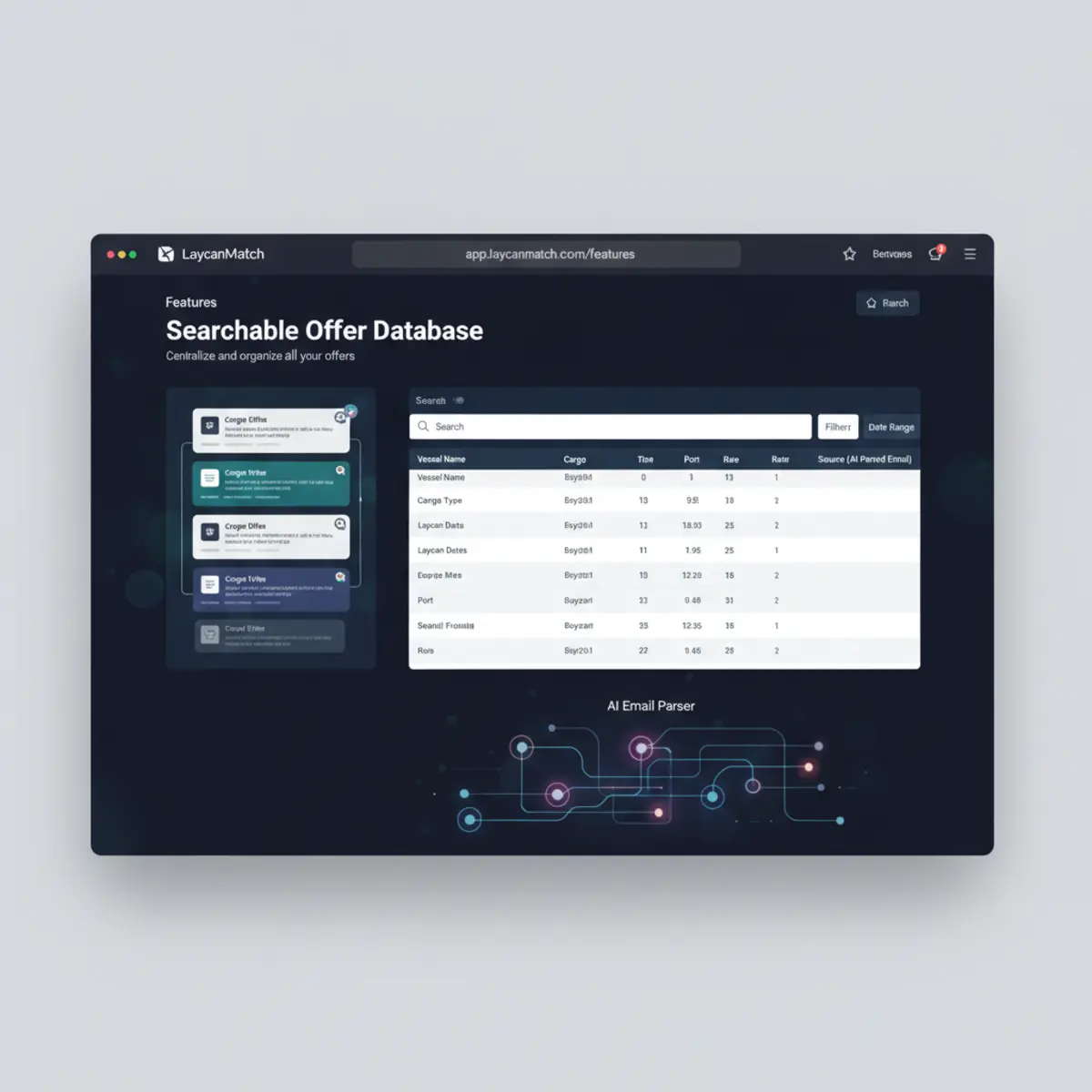
LaycanMatch parses authorized broker email content into structured cargo and vessel offer records, allowing commercial chartering desks to convert inbox traffic into queryable data.
The platform supports composite email handling, generating multiple independent offer records from a single incoming circular when multiple positions or orders are listed. Every generated record explicitly retains its source email metadata, original raw text snippet, confidence metrics, and operational review state, ensuring full traceability back to the broker broadcast.
Parsed records directly support both cargo-for-vessel and vessel-for-cargo matching workflows. For testing and integration evaluation, new accounts receive a 1,000 processed-email free allowance, while the public parser operates with zero input-text retention after delivering its response.