01

Understanding LaycanMatch's Cargo-Vessel Matching Scores

LaycanMatch's cargo-vessel matching scores provide a crucial quantitative measure of compatibility between available cargo and vessels, moving beyond simple keyword matching to evaluate true operational and commercial fit. These scores result from a sophisticated algorithm that analyzes multiple critical factors derived from parsed offer emails. The system comprehensively assesses each offer, integrating real-time data on Laycan, Deadweight Tonnage (DWT), specific routes, data confidence, and offer recency.

This multi-faceted approach ensures that generated scores are highly accurate and actionable. For shipbrokers, this means quickly identifying the most promising matches, significantly reducing the time and effort traditionally spent on manual comparisons. The objective is to enhance efficiency, minimize human error, and accelerate the deal-making process. By providing a clear, ranked list of compatible options, brokers can focus on high-potential opportunities rather than sifting through irrelevant data.

This systematic evaluation empowers faster, more informed decisions. Our scoring mechanism transforms raw offer data into strategic intelligence, making the complex process of

02

The Core Components: Laycan and DWT

The Laycan (Laytime Cancellation) period and Deadweight Tonnage (DWT) are fundamental parameters in determining a cargo-vessel match score. LaycanMatch meticulously extracts and compares these dates from offer emails, penalizing mismatches and rewarding overlaps. A perfect Laycan alignment between a cargo requirement and a vessel's availability significantly boosts the match score, indicating immediate operational feasibility.

Similarly, DWT represents the maximum weight a vessel can carry, including cargo, fuel, and supplies. The algorithm assesses if a vessel's DWT capacity aligns appropriately with the cargo's tonnage. An optimal match occurs when the vessel's DWT comfortably accommodates the cargo's weight, without being excessively oversized or undersized, which could lead to inefficiency or inability to transport.

This ensures not only that the cargo can be physically carried but also that the vessel is economically suitable for the consignment. Precise Laycan and DWT comparisons are cornerstones of accurate matching, preventing brokers from wasting time on physically or chronologically impossible pairings.

Master Cargo-Vessel Match Scoring
03

Route Optimization: Matching Geographical Pathways

Route optimization is a critical factor in LaycanMatch's scoring, ensuring geographical compatibility between cargo origin, destination, and a vessel's current position and intended next voyage. The system analyzes the ports mentioned in both cargo and vessel offers, including loading and discharging locations, to determine the most efficient and logical route alignment. A direct match or a route that minimizes deviation and backtracking will yield a higher score.

For instance, a vessel positioned in the Mediterranean seeking cargo for Asia will score higher for an Asia-bound cargo offer originating from the same region, compared to one requiring a transatlantic journey. LaycanMatch leverages advanced geospatial algorithms to calculate distances and assess route feasibility, taking into account common maritime corridors and transit times. This process goes beyond simple port-to-port comparisons, considering the overall flow of trade and a vessel's operational context.

By identifying routes that make economic and logistical sense, LaycanMatch helps brokers avoid costly deadheading or long repositioning voyages, directly contributing to more profitable fixtures. This intelligent

04

Confidence Score: Assessing Data Reliability

The confidence score reflects the algorithm's certainty about the accuracy and completeness of the extracted data for a given offer, influencing its overall match potential. LaycanMatch utilizes AI-powered email parsing to extract vital information from unstructured text. However, the quality of the incoming email (e.g., clarity, completeness, sender's format) can vary. The confidence score quantifies this variability.

If an email clearly states all parameters like Laycan dates, DWT, and specific ports without ambiguity, the confidence score will be high. Conversely, if information is vague, incomplete, or requires inferencing, the confidence score will be lower, indicating potential data gaps or ambiguities. This metric allows brokers to understand the reliability of the underlying offer data. A high-confidence offer means the system is very sure about its extracted details, making it a dependable candidate for matching.

A low-confidence score acts as a flag, prompting brokers to verify details manually before committing. This transparency is crucial for managing expectations and mitigating risks. It ensures that match scores are not solely based on numerical calculations but

05

Recency Factor: Valuing Timeliness in Offers

The recency factor assigns higher weight to newer, more current cargo and vessel offers, reflecting the dynamic and time-sensitive nature of the shipping market. In the fast-paced world of maritime chartering, offers can become stale or invalid quickly. A vessel's position changes, cargo requirements evolve, and market rates fluctuate.

LaycanMatch's algorithm incorporates a decay function that gradually reduces the score of older offers, ensuring that brokers are always presented with the most up-to-date and relevant opportunities. An offer received yesterday will inherently receive a higher recency weighting than an offer from last week, assuming all other match parameters are equal. This mechanism prevents brokers from spending valuable time pursuing opportunities that are likely no longer available or have changed significantly.

It prioritizes fresh data, encouraging prompt action and enabling brokers to react swiftly to market movements. By emphasizing recency, LaycanMatch ensures that the presented match scores reflect the current market reality, optimizing the broker's efficiency and increasing the likelihood of successful fixtures. This focus on timeliness is essential for

Master Cargo-Vessel Match Scoring
06

Enhancing Broker Productivity with Precise Matching

LaycanMatch's sophisticated scoring mechanism demonstrably enhances broker productivity by automating the initial, labor-intensive stages of cargo-vessel matching. Traditionally, brokers would manually sift through hundreds of emails daily, comparing Laycan, DWT, and routes across countless offers. This process is not only time-consuming but also prone to human error, leading to missed opportunities or inefficient fixtures.

Our AI-driven system streamlines this by instantly processing incoming offers, extracting critical data, and generating a ranked list of the most compatible matches. This means brokers spend less time on administrative tasks and more time on strategic negotiations and relationship building. The accuracy of the match scores, derived from a multi-factor analysis, ensures that brokers are presented with truly viable options, eliminating the need to manually cross-reference basic parameters.

By significantly reducing the workload associated with initial screening, LaycanMatch allows brokers to handle a larger volume of inquiries with greater precision, improving overall operational efficiency. This results in more fixtures, higher revenue potential, and a stronger

07

LaycanMatch in Action: The Automated Matching Workflow

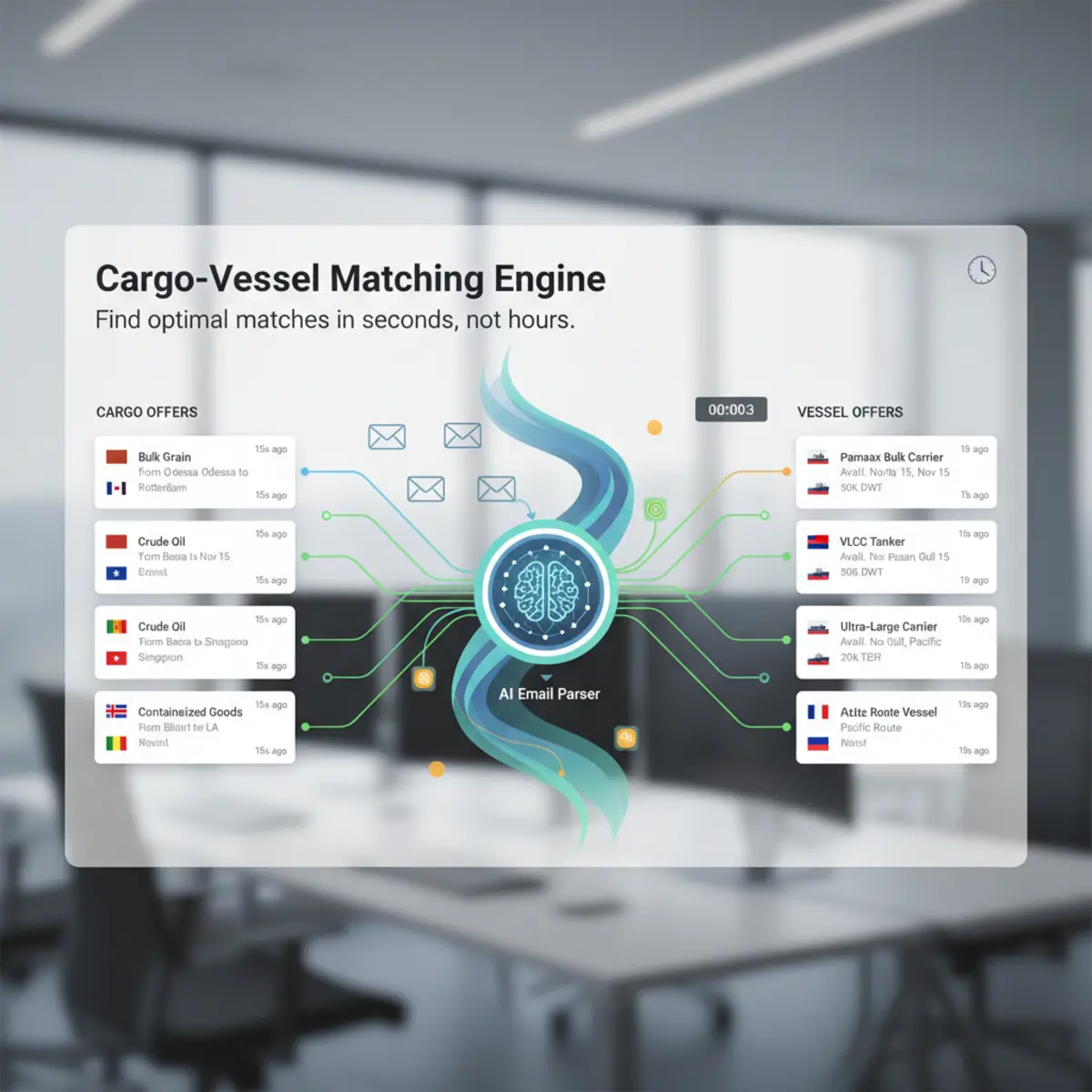
The LaycanMatch automated matching workflow begins the moment a cargo or vessel offer email is received and parsed by our AI, seamlessly integrating into a broker's daily operations. Upon ingestion, the AI automatically extracts all relevant data points: Laycan dates, DWT, loading/discharging ports, cargo type, and more. This structured data then feeds into the matching algorithm, which instantly compares the new offer against the entire searchable database of available cargo and vessels.

The system calculates a match score for every potential pairing, considering Laycan, DWT, route, confidence, and recency. Brokers are then presented with an intuitive dashboard displaying these ranked matches, often categorized or filtered based on user preferences. They can quickly visualize the best fits, view detailed offer information, and initiate contact. The integrated map route visualization feature further enhances this workflow, allowing brokers to confirm geographical feasibility at a glance.

This continuous, real-time processing and scoring transform reactive manual searching into a proactive, intelligent matching process, empowering brokers to respond to market opportunities with

08

Why LaycanMatch's Holistic Scoring Outperforms Simple Filtering

LaycanMatch's holistic scoring model provides a significant advantage over basic filtering tools or manual comparison methods by offering a nuanced and comprehensive assessment of compatibility. Simple filtering might narrow down options based on one or two criteria, but it fails to capture the intricate interplay of multiple factors like simultaneous Laycan, DWT alignment, optimal route, data confidence, and offer recency.

Our system doesn't just check boxes; it quantifies the degree of fit across all these dimensions, presenting a weighted score that reflects true operational viability and commercial attractiveness. This prevents valuable opportunities from being overlooked due to a slight mismatch in a single parameter, while simultaneously highlighting truly unsuitable options that might pass a basic filter.

For instance, a basic filter might show all vessels with DWT > X, but LaycanMatch intelligently flags if that vessel is too large, incurring unnecessary costs. By evaluating the entire context of an offer, LaycanMatch empowers brokers to make more informed decisions, leading to better fixtures and improved profitability. It moves beyond "possible" to identify the