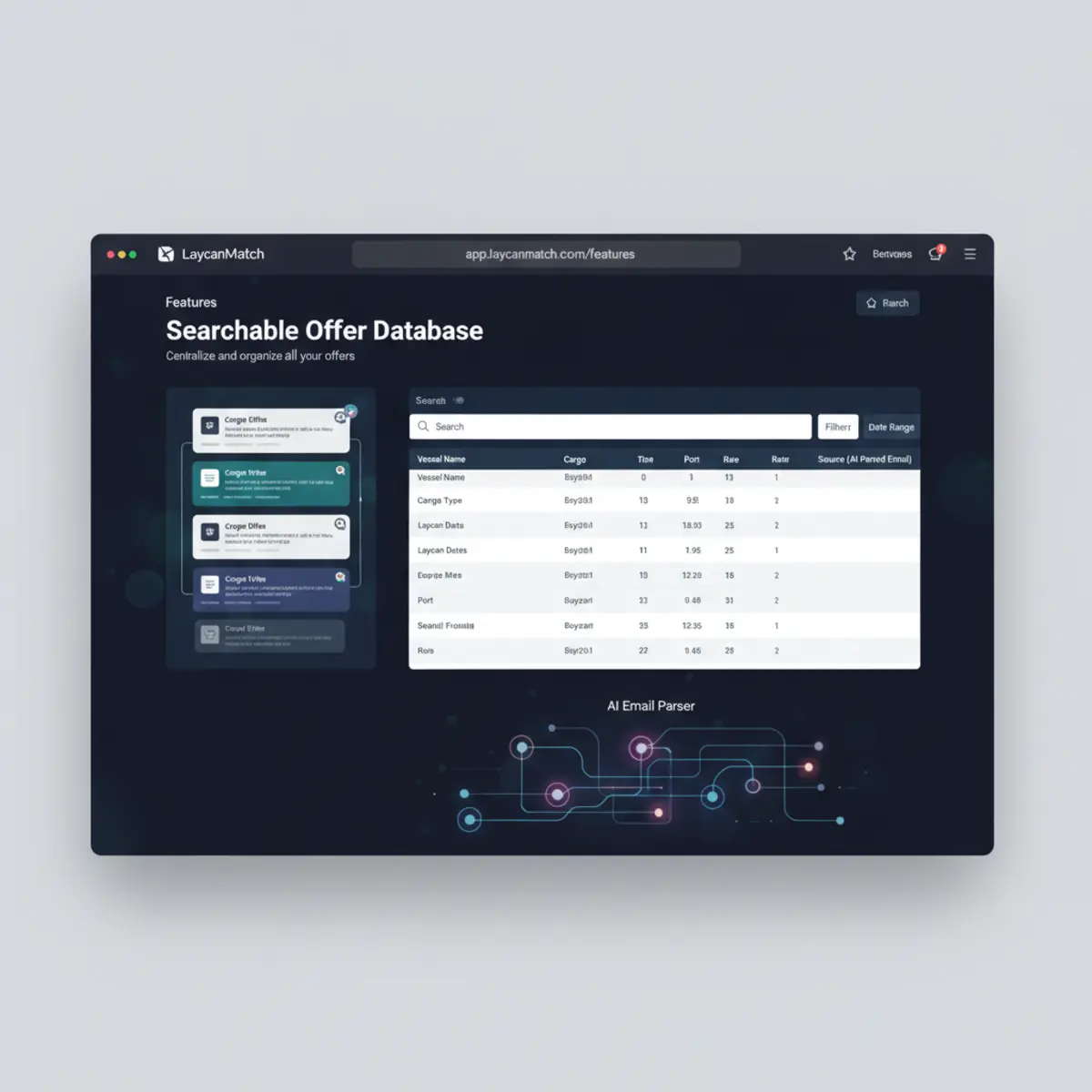
Why Historical Broker Circulars Present Search Challenges
Shipbroking desks receive hundreds or thousands of commercial circulars every day across dry bulk, tanker, and container segments. Over years of trading, these messages accumulate into extensive archives containing valuable commercial context, past freight indications, vessel position updates, and cargo requirements.
However, standard email clients such as Microsoft Outlook or Gmail index messages as raw unstructured text strings. Searching for a Handysize vessel opening in the Mediterranean with specific gear requirements often yields either zero relevant results or hundreds of unrelated message threads. The underlying data remains trapped behind irregular formatting, maritime jargon, non-standard abbreviations, and embedded tables.
Extracting utility from historical broker communications requires a structured approach where individual offers within circulars are isolated, extracted into discrete data fields, and linked back to their original context for commercial verification.
Standard Email Search versus Parametric Maritime Querying
| Capability | Standard Inbox Search (Outlook / Gmail) | Structured Maritime Offer Database |
|---|---|---|
| Laycan Window Filtering | Filters only by email received timestamp | Filters by parsed commencing and cancelling laycan dates |
| Port & Geography Search | Exact string match only (misses regional synonyms) | Evaluates port aliases and regional trading areas |
| Vessel Specification Search | Unstructured text match without numeric boundary checks | Range-based numeric filtering for DWT, draft, cubic capacity, and gear |
| Multi-Offer Circulars | Treats entire multi-position email as one monolithic text | Splits individual vessel positions and cargo orders into separate records |
| Source Verification | Manual scrolling through long conversation threads | Direct reference to raw snippet, confidence score, and source email |
| Duplicate Handling | Returns every forwarded duplicate across all senders | Preserves distinct sender submissions with traceable message origins |

Structural Properties Extracted from Historical Freight Circulars
Commercial circulars generally fall into two primary record categories: vessel position lists and cargo orders. An email parser designed for maritime text scans authorized message archives to identify specific operational and commercial attributes.
For vessel positions, the parser seeks parameters such as the vessel name, IMO number (when provided), deadweight tonnage (DWT), draft, year of build, vessel cubic capacity, gear configurations (such as crane capacity and grab presence), current or opening port, and the open laycan date spread.
For cargo orders, the extraction targets commodity description, quantity, operational tolerance terms (such as MOLOO or MOLCO), maximum stowage factor, load port, discharge port, laycan spread, loading and discharging rates, and proposed commission structures or freight indications. When these data points are transformed into relational records, commercial operators can query past market conditions based on technical compatibility rather than text guesswork.
Example of Unstructured Circular Parsing into Structured Offers
Consider a typical consolidated dry bulk circular received from a co-broker containing multiple distinct positions:
Raw Text Input:
"OPEN TONNAGE:
1. MV NORDIC PRIDE - BLT 2017 - 63,500 DWT ON 13.3M - GRD 4X30T - OPEN SINGAPORE 15/20 MAY
2. MV PACIFIC WAVE - BLT 2012 - 56,800 DWT ON 12.8M - GRD 4X35T + GRABS - OPEN S.CHINA 22/26 MAY
CARGO REQT:
ACCT ABC CORP - 50,000/10 WHEAT - US GULF / TAIWAN - 01/10 JUNE - 8000C/4000C - 3.75%"
Parsed Output Structure:
When processed, this single email produces three distinct records. The first record stores MV NORDIC PRIDE as an Ultramax bulk carrier open Singapore with a laycan of May 15 to May 20. The second record stores MV PACIFIC WAVE as a Supramax bulk carrier open South China with a laycan of May 22 to May 26. The third record stores a 50,000 MT wheat cargo order for account ABC Corp loading US Gulf and discharging Taiwan for June 1 to June 10 laycan.
Each extracted record retains its source email metadata, exact raw snippet, assigned confidence score, and verification state.
Workflow for Ingesting and Searching Past Circular Archives
- 01
Archive Ingestion Setup
Authorize the ingestion pipeline to access targeted historical email folders, shared mailboxes, or historical message archives.
- 02
Automated Parsing Extraction
Run parsing models across the authorized archive to separate circulars into distinct cargo and vessel offer records.
- 03
Review Confidence Scores
Flag low-confidence extractions or incomplete parameters for manual review to maintain data integrity.
- 04
Apply Parametric Queries
Query the resulting database using structured constraints such as deadweight ranges, laycan date bounds, and trade corridors.
- 05
Audit Against Raw Text
Inspect the parsed offer against the original email body snippet and timestamp to verify terms before commercial action.
Managing Complexities: Multiple Offers, Aliases, and Duplicates
Historical broker archives present specific data management challenges that require deliberate handling. A single daily market summary or position sheet often contains dozens of distinct ships or cargo orders. A robust data architecture must split these multi-item emails into separate searchable entities rather than indexing the message as a single block.
Geographic references also introduce complexity. Brokers regularly use colloquial port abbreviations, berth names, or regional basin terms (such as "USG", "ECSA", "ARA", or "WCI"). Systems evaluating maritime records must normalize these references against recognized geographic entities or UN/LOCODE standards to ensure that a search for a broad region captures relevant sub-ports.
Furthermore, the same vessel position or cargo requirement is frequently circulated by multiple co-brokers with minor wording variations. In a governed database, every parsed record maintains its full provenance, showing which broker circulated the position, at what time, and with what exact terms, enabling chartering teams to evaluate broker coverage and reach.
Commercial Use Cases for Querying Past Broker Communications
Access to a structured historical archive supports several routine commercial operations across chartering desks and broking houses:
1. Off-Market Tonnage Identification: When spot market position lists show limited availability in a given region, searching historical archives for vessels that previously opened or discharged in adjacent ports provides candidate tonnage for direct inquiry.
2. Historical Rate and Term Benchmarking: Reviewing past freight indications, demurrage rates, and commission structures quoted on specific routes during prior quarters establishes useful context when preparing freight estimates or evaluating incoming counter-offers.
3. Counterparty Activity Tracking: Desks can review which charterers or operators have historically circulated firm orders for specific commodities and trade lanes, helping teams prioritize outbound marketing and broker communications.
4. Seasonal Pattern Review: Historical searches allow operators to review past laycan volumes across agricultural harvests, mineral export seasons, or winter fuel demand cycles.
Operational Boundaries for Historical Email Parsing Systems
| Functional Scope | System Capability | Operational Boundary & Manual Requirement |
|---|---|---|
| Offer Extraction | Parses text into vessel and cargo records | Does not guarantee 100% extraction accuracy; human review required |
| Laycan & Date Bounds | Normalizes reported dates into structured fields | Does not calculate voyage ETA or predict future arrival dates |
| Geographic Normalization | Associates port strings with standard locational entities | Does not account for dynamic canal delays, drafts, or port closures |
| Record Matching | Supports cargo-for-vessel and vessel-for-cargo filtering | Does not perform automated negotiation, rate calculation, or fixture execution |
| Data Retention | Retains source email context for auditability | Public evaluation endpoints do not retain input text after processing |
Evaluating Structured Search with LaycanMatch
LaycanMatch provides specialized parsing infrastructure designed to convert authorized broker email content into structured cargo and vessel offer records. Because a single maritime circular often contains multiple orders or positions, the system automatically creates separate records for each distinct item identified.
Every parsed record within LaycanMatch preserves its direct lineage, linking back to the source email, the unedited raw text snippet, an extraction confidence rating, and an explicit review state. This structure allows commercial teams to filter opportunities across both cargo-for-vessel and vessel-for-cargo workflows while maintaining strict data governance.
Teams evaluating their email workflows can test extraction behavior using the LaycanMatch public parser, which operates with zero input-text retention after delivering its parsing response. New accounts receive a 1,000 processed-email free allowance to assess extraction performance across their own real-world historical archives.