The Searchability Problem in High-Volume Chartering Inboxes
Chartering desks routinely handle thousands of incoming messages each day across regional distribution lists, direct broker contacts, and commercial operators. These communications arrive as unstructured circulars, tonnage updates, cargo inquiries, and partial quote summaries.
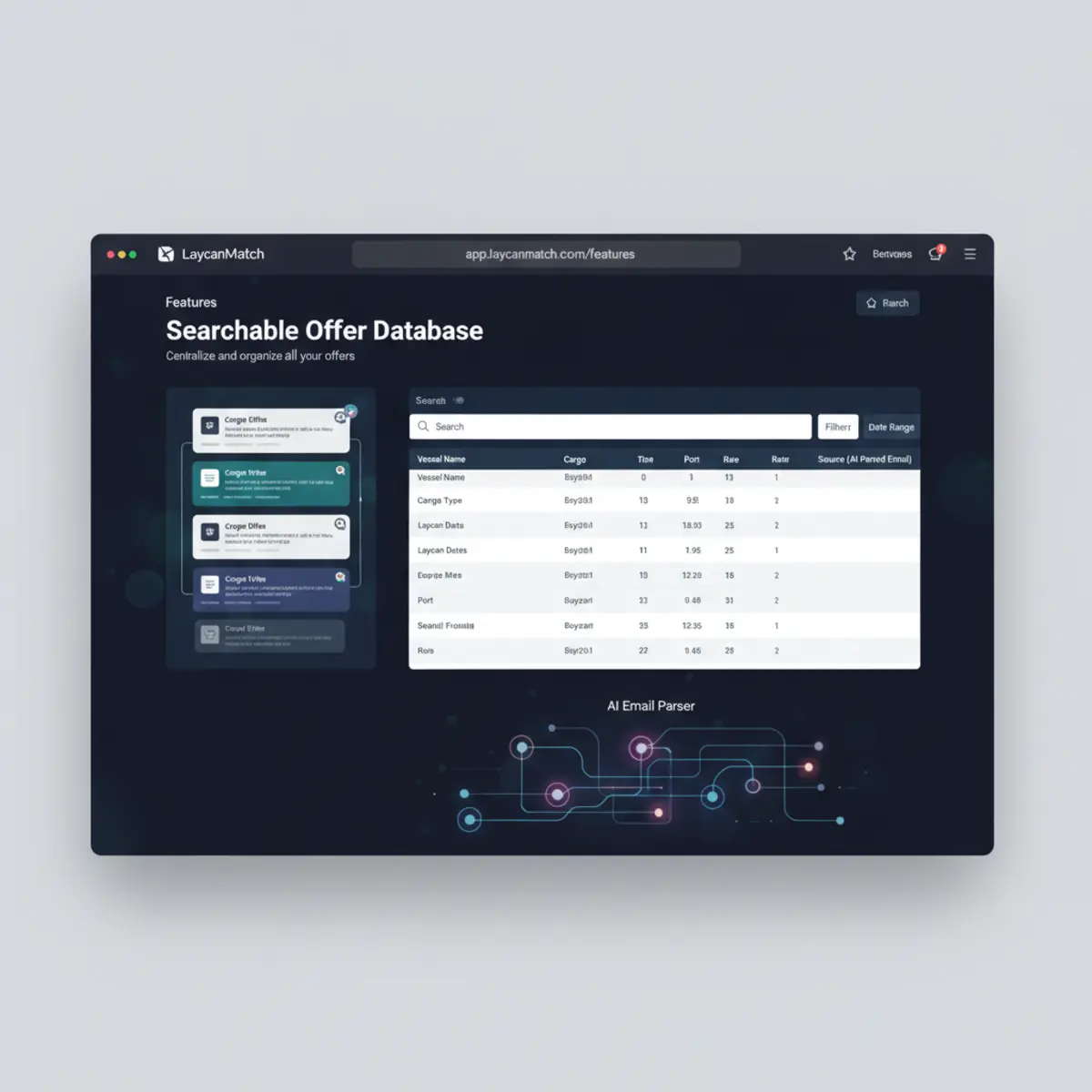
Traditional email clients index messages purely by generic text strings and email headers. When a broker searches for tonnage, a keyword query fails to understand date windows, geographic proximity, draft restrictions, or cargo stowage factors. Consequently, relevant market tonnage received earlier in the day is quickly buried under subsequent message traffic.
Without structured extraction, vital commercial context remains isolated within individual subfolders or fragmented email chains. Desks lose operational efficiency when brokers must manually skim through hundreds of messages to find a suitable vessel or re-read circulars to confirm open dates and crane specifications.
Core Data Points Needed for Structured Maritime Context
Preserving useful commercial context requires extracting specific, standardized data points from unstructured broker correspondence rather than relying on raw text summaries alone.
For vessel positions, the core fields include vessel name, IMO number when available, deadweight tonnage (DWT), cubic capacity, gear configurations (such as crane count and safe working load), current open location or range, and the laycan readiness window. For cargo orders, critical fields encompass commodity description, parcel quantity and tolerance (such as MOLOO terms), laycan dates, load and discharge ports or ranges, stowage factor, and indicated freight terms.
Standardizing these variables allows commercial operators and brokers to execute precise queries across multi-day correspondence without losing the original commercial phrasing provided by the source sender.

Essential Cargo and Vessel Extraction Fields
| Category | Extracted Field | Representative Value | Operational Function |
|---|---|---|---|
| Vessel Position | Vessel Identifier | MV Northern Dawn (IMO 9345123) | Anchors records to specific tonnage and enables fleet checks |
| Vessel Position | Open Port / Range | ARA / Rotterdam | Establishes departure baseline for voyage planning |
| Vessel Position | Laycan Window | 12 May - 18 May | Determines schedule compatibility against loading windows |
| Vessel Specifications | DWT / Draft / Gear | 55,000 DWT / 12.5m / 4x35t | Verifies physical suitability against berth and parcel limits |
| Cargo Requirement | Commodity & Quantity | 45,000 MT Wheat 5% MOLOO | Determines payload capacity and deadweight utilization |
| Cargo Requirement | Load / Discharge Range | US Gulf / Morocco | Establishes commercial route and port constraints |
| Commercial Context | Raw Message Provenance | Sender address and email timestamp | Preserves audit trail, intermediary attribution, and source text |
Intake and Extraction Workflow for Shared Broking Desks
- 01
Authorized Message Routing
Route incoming market circulars and order broadcasts from authorized broking mailboxes into the parsing pipeline.
- 02
Entity and Parameter Parsing
Parse message text to identify vessel names, technical specifications, cargo volumes, laycan dates, and geographic ranges.
- 03
Multi-Offer Record Creation
Split emails containing multiple vessel positions or cargo orders into discrete, independent offer records.
- 04
Context and Provenance Retention
Associate each structured record with its original source email, raw message text, extraction confidence, and initial review state.
- 05
Field-Level Query Ingestion
Index normalized fields into the desk repository to make laycans, ports, and tonnage limits immediately searchable across the team.
Managing Multi-Listing Circulars and Intermediary Noise
A recurring operational challenge in shipbroking inboxes is handling multi-listing circulars and duplicate market reports. A single email from an intermediary broker frequently contains a list of ten or more open vessels across different geographical sectors, or several distinct cargo orders with varying laycans.
If an intake system treats the entire email as a single record, search accuracy breaks down because unrelated vessel parameters and dates bleed into one another. The extraction system must parse each listing within the message into an individual structured offer record.
Furthermore, competing intermediaries frequently circulate the same underlying tonnage or cargo requirement with slight differences in wording or laycan formatting. Capturing source metadata, exact quotation text, and timestamps allows chartering teams to trace the origin of each report and verify whether an incoming circular represents a new market position or an alternative listing of an existing one.

Dissecting a Multi-Listing Email into Discrete Records
Consider an incoming market email containing the following body text:
'OPEN TONNAGE:
1) MV PACIFIC BREEZE - 63,500 DWT - 2018 BLT - 4X30T CR - OPEN SINGAPORE 10-15 MAY
2) MV OCEAN PRIDE - 38,000 DWT - 2015 BLT - 4X30T CR - OPEN S.CHINA 18-22 MAY'
When parsed into discrete offer records, the email produces two distinct database entities:
Record A:
- Vessel Name: MV PACIFIC BREEZE
- Deadweight: 63,500 DWT
- Built: 2018
- Gear: 4x30t Cranes
- Open Area: Singapore
- Laycan: 10 May - 15 May
- Source Context: Retains original sender, timestamp, confidence score, and unparsed snippet for Record A.
Record B:
- Vessel Name: MV OCEAN PRIDE
- Deadweight: 38,000 DWT
- Built: 2015
- Gear: 4x30t Cranes
- Open Area: South China
- Laycan: 18 May - 22 May
- Source Context: Retains original sender, timestamp, confidence score, and unparsed snippet for Record B.
Separating the data ensures queries for 38,000 DWT vessels open in South China do not erroneously match parameters associated with the larger Ultramax vessel in Singapore.
Evaluating Geographic and Laycan Search Capabilities
When evaluating how to search structured inbox records, chartering desks must understand the boundary between standardized text extraction and advanced geographic modeling.
Basic keyword searching cannot interpret whether a vessel open in Rotterdam is commercially positioned to lift a cargo loading in Antwerp. Standardized parsing models identify geographic entity names such as ports, sea areas, and load ranges from the email text. Teams can then filter records by matching named ports or broader operational ranges.
However, teams should be aware that converting non-standard port abbreviations into official UN/LOCODE entries or computing precise nautical distances, ballast routes, and arrival dates requires distinct operational layers. Desks should maintain clear internal standards for how regional aliases are recorded and verified by brokers during day-to-day search operations.
Implementing Bidirectional Match Workflows
- 01
Position Intake
Parse and register open vessel positions received from owners and technical operators into active tonnage records.
- 02
Cargo Requirement Ingestion
Parse and catalog incoming cargo orders, parcel requirements, and tender circulars into active demand records.
- 03
Vessel-for-Cargo Matching
Query existing tonnage records matching specific cargo parameters, checking laycan windows, capacity limits, and crane requirements.
- 04
Cargo-for-Vessel Matching
Query active cargo records matching an open vessel position based on the vessel available dates and geographic positioning.
- 05
Broker Verification and Outreach
Review matched candidates against raw source circulars to confirm accuracy before proceeding with commercial negotiations.
Operational Scope: Extraction vs Voyage and Commercial Execution
| Workflow Stage | Structured Extraction Tool | External Operational System | Human Commercial Broker |
|---|---|---|---|
| Circular Ingestion | Parses text from authorized emails into structured offers | Stores raw email archives in messaging tenant | Configures routing and mailbox permissions |
| Data Dissection | Splits multi-vessel circulars into discrete records | None | Audits unparsed text and validates record accuracy |
| Position Matching | Filters cargo-for-vessel and vessel-for-cargo records | Computes complex bunker and weather-routed voyage legs | Evaluates counterparty standing and commercial terms |
| Voyage Estimation | Extracts indicated freight ideas or demurrage rates | Executes detailed Time Charter Equivalent (TCE) modeling | Determines commercial bidding strategy |
| Fixture Conclusion | Retains review state and linked raw message text | Manages formal contract drafting and recap archiving | Negotiates charterparty terms and final fixture execution |
Human Review, Confidence Scores, and Verification Controls
No parsing process can guarantee complete accuracy across the endless variations of informal broking shorthand, typos, and fragmented formatting found in daily email streams. Responsible desk operations require human verification controls built directly into the data workflow.
To support verification, structured extraction engines provide confidence scores and explicit review states alongside parsed fields. When a broker opens a parsed record, the system displays the extracted values alongside the original source text snippet.
If an ambiguous circular omits the laycan year or uses non-standard terms, the assigned broker can inspect the flagged record, review the underlying email context, update the fields manually, and confirm the review state. This verification loop keeps the shared desk database reliable without discarding ambiguous messages.
Getting Started with Structured Broking Workflows
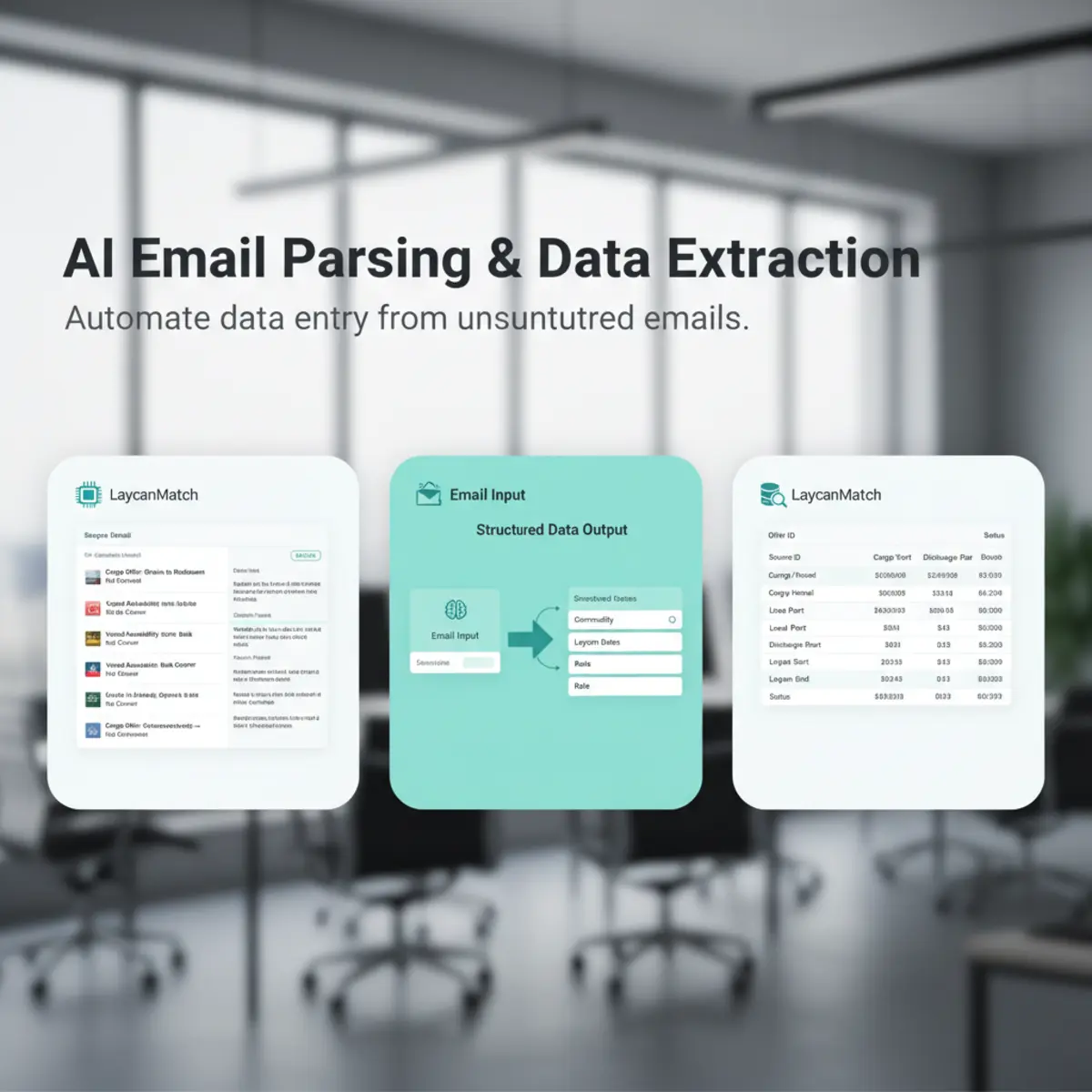
Chartering teams seeking to improve searchability across shared inboxes can implement structured parsing through dedicated platforms such as LaycanMatch. LaycanMatch parses authorized broker email content into discrete cargo and vessel offer records, allowing one email to generate multiple structured records.
Each extracted record retains its source email context, raw text, confidence score, and review state, providing full auditability for matching workflows across both cargo-for-vessel and vessel-for-cargo requirements. New accounts have a 1,000 processed-email free allowance to evaluate parsing workflows across live market circulars.
For teams testing parsing behavior on individual circulars before connecting email streams, the LaycanMatch public parser processes input text with zero input-text retention after its response, ensuring test data is not stored.