Fundamentals of Laycan Windows and Presentation Dates
In voyage chartering, the term laycan defines the contractually agreed boundary dates governing vessel presentation at the designated loading port. The first date, known as the laydays commencement, represents the earliest time the charterer is required to accept the vessel and provide cargo. The final date, known as the cancelling date, establishes the deadline by which the shipowner must tender a valid Notice of Readiness (NOR) showing the vessel is ready to load in all respects.
Laycan overlap occurs when a vessel's projected arrival timeline directly coincides with this cargo availability window. If an open vessel's estimated time of arrival (ETA) falls entirely before the laydays begin or after the cancelling date passes, commercial alignment fails. Establishing whether an operational overlap exists is the primary technical filter brokers and commercial operators apply before assessing freight rates, stowage factors, and vessel deadweight compatibility.
Commercial Implications of Arrival Timing Margins
The position of a vessel's ETA relative to the laycan spread determines the commercial balance and risk profile of a proposed voyage. When a ship arrives significantly earlier than the opening layday, the charterer is under no legal obligation to commence loading operations or start counting laytime early.
The vessel must wait at anchor or drift at the shipowner's operational expense, burning auxiliary fuel and losing commercial utilization days until the laydays commence or the charterer voluntarily accepts early readiness.
Conversely, presenting a vessel after the agreed cancelling date exposes the owner to severe commercial exposure. Standard charter party forms grant the charterer the unilateral legal right to cancel the contract or demand a renegotiated, lower freight rate if the vessel fails to tender NOR before the cancelling deadline. Consequently, commercial operators avoid fixing on narrow arrival margins unless protective charter party clauses or clear operational buffers are established.

Operational Classification of Laycan Alignment Categories
| Overlap Category | ETA Relative to Laycan Spread | Operational Buffer Range | Primary Commercial Risk Factor | Recommended Commercial Action |
|---|---|---|---|---|
| Optimal Spread | ETA lands on Days 1-2 of window | +48 to +72 Hours | Negligible presentation risk | Proceed to evaluate commercial terms and stowage |
| Tight Presentation | ETA lands on final 24 hours of window | 0 to +24 Hours | Vulnerable to minor transit delays | Negotiate wide speed warranties and slippage clauses |
| Early Presentation | ETA precedes opening layday by 48+ hours | Negative lead margin | Uncompensated idle waiting time | Assess slow-steaming economics or request early loading |
| Cancelling Breach | ETA exceeds cancelling date | Negative arrival buffer | Unilateral charterer cancellation | Reject fixture or negotiate formal laycan extension |
| Disjointed Window | No chronological intersection | Incompatible dates | Infeasible operational pairing | Filter out opportunity and reassign vessel opening |
Primary Operational Drivers of Laycan Slippage
Even when initial calculations show a favorable laycan overlap, operational variables along the ballast route can cause schedule slippage. The single largest source of slippage is unexpected delay at the vessel's preceding discharge port. Port congestion, slow discharge rates, customs clearance bottlenecks, and local labor disputes frequently push back a vessel's departure date, eroding the safety buffer built into the subsequent voyage plan.
En-route factors introduce further schedule variance. Unfavorable sea states, head currents, and seasonal weather systems force vessels to reduce speed or alter course, adding transit time. Unscheduled waiting times at maritime transit chokepoints, such as the Suez Canal, Panama Canal, or Bosphorus Strait, alongside required deviations for offshore bunkering or crew changes, can rapidly consume a multi-day buffer, turning a feasible laycan overlap into a potential cancellation default.
Operational Workflow for Screening Laycan Feasibility
- 01
Extract stated cargo laycan spread
Identify the opening layday and final cancelling date from the freight inquiry or broker circular.
- 02
Determine open vessel position
Verify the current discharge port, expected time of completion, and vessel readiness state from the position list.
- 03
Calculate ballast transit duration
Determine sea mileage to the load port based on standard routing, applying realistic average sea speeds rather than idealized calm-water speeds.
- 04
Apply route-specific operational buffers
Add conservative time allowances for seasonal weather degradation, canal queuing, and planned bunkering stops.
- 05
Evaluate arrival against cancelling threshold
Compare the adjusted arrival date against the cargo laycan to ensure the vessel tenders NOR with an adequate safety margin prior to the cancelling deadline.

Scenario Analysis: Evaluating Buffered vs. Deficit Overlaps
Consider a Supramax dry bulk cargo open in Richards Bay with a laycan window of October 10 to October 15. A chartering desk identifies two potential open vessels from market circulars.
Vessel A completes discharge in Durban on October 6 with an estimated 36-hour transit to Richards Bay. Its baseline ETA is October 8, providing two full days before laydays open and seven days before the cancelling date. The operator can slow-steam to conserve bunker fuel while comfortably meeting the presentation window.
Vessel B is scheduled to discharge in Singapore, completing on October 1. The ballast transit across the Indian Ocean requires approximately 13 days at 12 knots, yielding an estimated arrival of October 14. Because this leaves less than 24 hours of buffer before the October 15 cancelling date, any monsoon weather delay or Singapore bunker backlog will cause the vessel to miss the cancelling date. Vessel B represents a high-risk commercial candidate requiring formal laycan extension before fixing.
Handling Variable Date Formats in Commercial Market Circulars
Shipbroking circulars arrive in hundreds of unstructured email messages daily, using diverse and non-standardized phrasing to represent laycan windows. Brokers routinely write dates in shortened formats such as 10-15 OCT, 25/11-05/12, MID NOV, or prompt designations like PPT or SPOT. In dry bulk and tanker desks handling high circular volume, manually standardizing these expressions into usable date records creates significant administrative overhead.
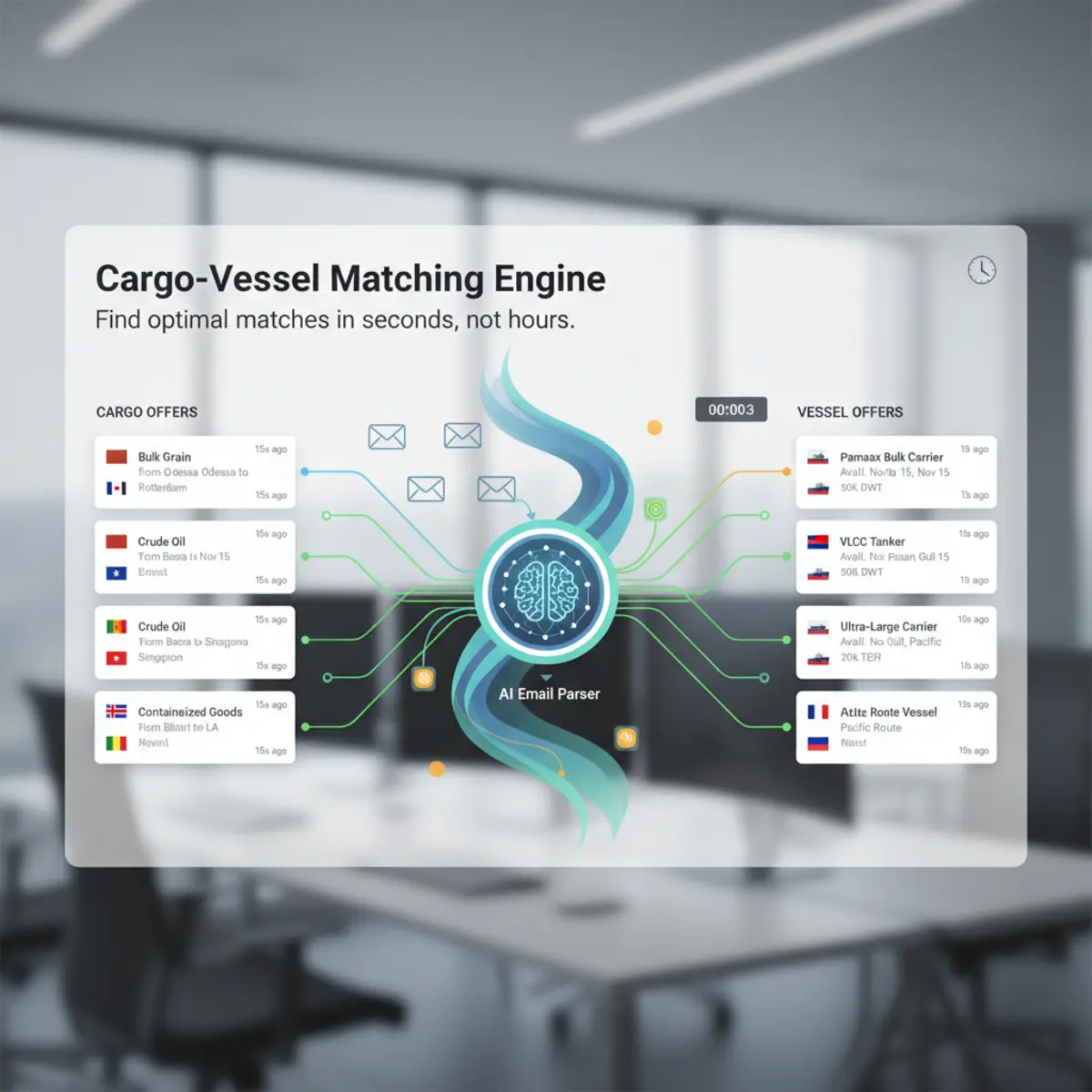
Normalizing this data requires structured date parsing that translates regional calendar conventions and maritime shorthand into standardized date ranges. LaycanMatch addresses this parsing challenge by processing authorized broker email content directly into structured cargo and vessel offer records.
Because a single market circular often contains multiple orders or fleet positions, the system parses these into individual records, retaining the source email, raw text excerpt, confidence indicator, and review state for auditability.
Operational Scope: Ingestion Platforms vs. Commercial Decision Making
| Operational Dimension | Data Parsing and Offer Ingestion | Commercial Chartering and Execution Desk |
|---|---|---|
| Laycan Data Extraction | Parses raw text into standardized date fields | Assesses validity of extracted dates against market context |
| Route Feasibility | Records reported vessel open locations and dates | Calculates exact sea transit times, speeds, and canal queues |
| Risk Assessment | Flags text confidence and parsing review status | Evaluates commercial risk of tight buffers and market exposure |
| Contract Execution | Stores source email text for verification | Negotiates charter party terms, freight rates, and cancelling clauses |
| Workflow Direction | Supports cargo-for-vessel and vessel-for-cargo matching | Selects counterparties and executes final binding recap terms |
Commercial Clauses and Buffer Strategies for Risk Management
When commercial teams decide to pursue a cargo with a narrow laycan overlap, they employ specific charter party mechanisms to mitigate cancellation exposure. One standard mechanism is the incorporating of an interpolation clause or an explicit laycan extension clause.
Under standard BIMCO or industry-specific contracts, if an owner realizes the vessel will arrive past the cancelling date due to voyage contingencies, these clauses obligate the charterer to declare within a specified timeframe (e.g., 48 hours) whether they intend to cancel the charter or agree to an amended, extended cancelling date.
Additionally, operators manage arrival windows dynamically through variable speed orders. If a vessel is running ahead of an opening layday, operational management can order the master to adopt an ultra-slow steaming speed, reducing fuel consumption while aligning arrival with the opening of laytime. Conversely, if an operational delay threatens the cancelling date, charterers and owners may agree on warranted speed-up terms, balancing the increased bunker expenditure against the risk of an uncommitted open vessel.
Configuring Ingestion and Matching Workflows
- 01
Forward inbound broker circulars
Route authorized market circulars into the ingestion pipeline to parse unstructured messages into structured records.
- 02
Review parsed offer records
Check generated cargo and vessel offers alongside their source text, extraction confidence, and review state.
- 03
Filter by operational windows
Screen available cargo records against open vessel positions using customized date margins and geographic criteria.
- 04
Execute matching queries
Utilize cargo-for-vessel or vessel-for-cargo matching workflows to identify overlapping opportunities within the active order pipeline.
- 05
Verify terms with counterparty
Reference the stored source email to confirm specific commercial details before initiating formal negotiations.