Cargo Requirement Ingestion and Parameter Setup
Shipbroking desks and charterers establish cargo requirements to represent commercial shipping demand. These requirements originate either from manual operational entry or from inbound market communication sent by charterers and co-brokers.
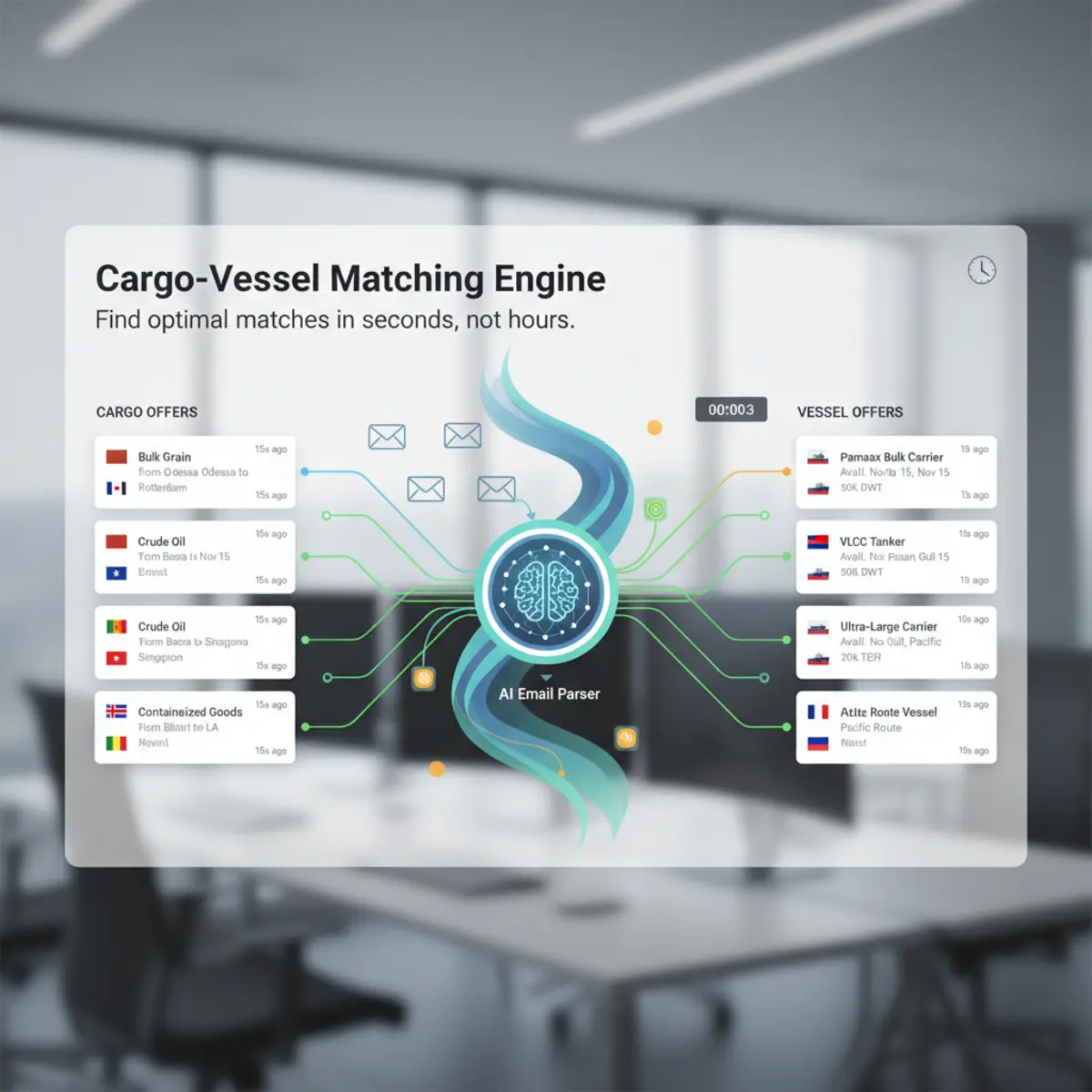
When cargo details arrive through authorized broker email channels, software parsing converts unstructured text into structured cargo records. Because market circulars vary widely in syntax, a standardized cargo record must capture essential parameters: commodity description, parcel volume, volume tolerance (such as MOLOO or Min/Max), stowage factor, load port or range, discharge port or range, laycan spread, and specific gear or technical restrictions.
Manual configuration remains essential for bespoke tenders, direct cargo orders, or orders received over direct messaging channels. Regardless of how the record is generated, establishing clear commercial boundaries upfront ensures that downstream matching against open vessel positions produces relevant operational candidates.
Standard Workflow for Setting Up a Cargo Requirement
- 01
Define cargo quantity and volume tolerances
Enter the contractual parcel size in metric tons alongside operational tolerances such as MOLOO (More or Less in Owner's Option) or Min/Max limits to define acceptable vessel deadweight ranges.
- 02
Specify stowage factor and physical characteristics
Input cubic measurements per metric ton to determine total hold cubic capacity required, preventing stowage shortfall on high-volume or light commodities.
- 03
Set load and discharge geography
Define discrete load and discharge berths, ports, or geographic ranges such as US Gulf, Continent, or Japan-Korea range.
- 04
Establish laycan boundaries
Enter the earliest laydays date and the canceling date to define the acceptable vessel delivery or arrival window.
- 05
Record vessel technical restrictions
Detail maximum allowable vessel age, required crane safe working load (SWL), grab capacity, maximum arrival draft, and beam constraints.
- 06
Review extraction confidence and source text
For records parsed from incoming emails, verify that extracted values align with the underlying raw email body before publishing the order to active matching.

Core Operational Parameters Evaluated During Matching
| Operational Parameter | Commercial & Technical Variables | Operational Significance for Match Feasibility |
|---|---|---|
| Laycan Alignment | Laydays opening date, canceling date, open position date | Confirms whether vessel availability intersects with the required load window. |
| Geographic Proximity | Vessel open port/region, ballast distance to load range | Dictates ballast duration, preliminary routing feasibility, and fuel exposure. |
| Deadweight & Cubic Intake | Summer DWT, gross cubic capacity, cargo stowage factor | Verifies whether the vessel can lift the contractual quantity without deadfreight or draft violation. |
| Gear & Mechanical Specs | Crane capacity (SWL), grab fitted status, hold types | Ensures vessel compliance with terminal handling rules and cargo characteristics. |
| Draft & Dimensional Limits | Max arrival draft, beam, LOA, berth limitations | Prevents nominating tonnage that exceeds physical berth or canal limits. |
| Commercial Restrictions | Vessel age limits, flag state, club memberships, vetting | Filters out tonnage excluded by charterer vetting guidelines or trading restrictions. |
Laycan Alignment and Position Feasibility
Temporal alignment between a vessel's open date and the cargo laycan window is the primary screening filter in spot chartering. A vessel opening too late risks missing the canceling date, exposing the charterer to operational delays or giving them cause to cancel the charter party. Conversely, a vessel opening significantly ahead of the laycan may incur costly waiting time at anchor unless intermediate employment is secured.
Evaluating candidate tonnage requires assessing the vessel's reported open location against the cargo's loading range. While software systems identify whether an open date is chronologically compatible with a laycan window, calculating exact transit durations, weather allowances, speed-consumption trade-offs, and canal scheduling remains an operational calculation performed by the chartering desk or dedicated voyage estimation systems.
Technical Limits, Cubic Intake, and Draft Evaluation
A vessel may match a cargo requirement chronologically while remaining physically or technically unviable. Cargo matching workflows require verifying deadweight capacity against berth draft limitations and cargo density.
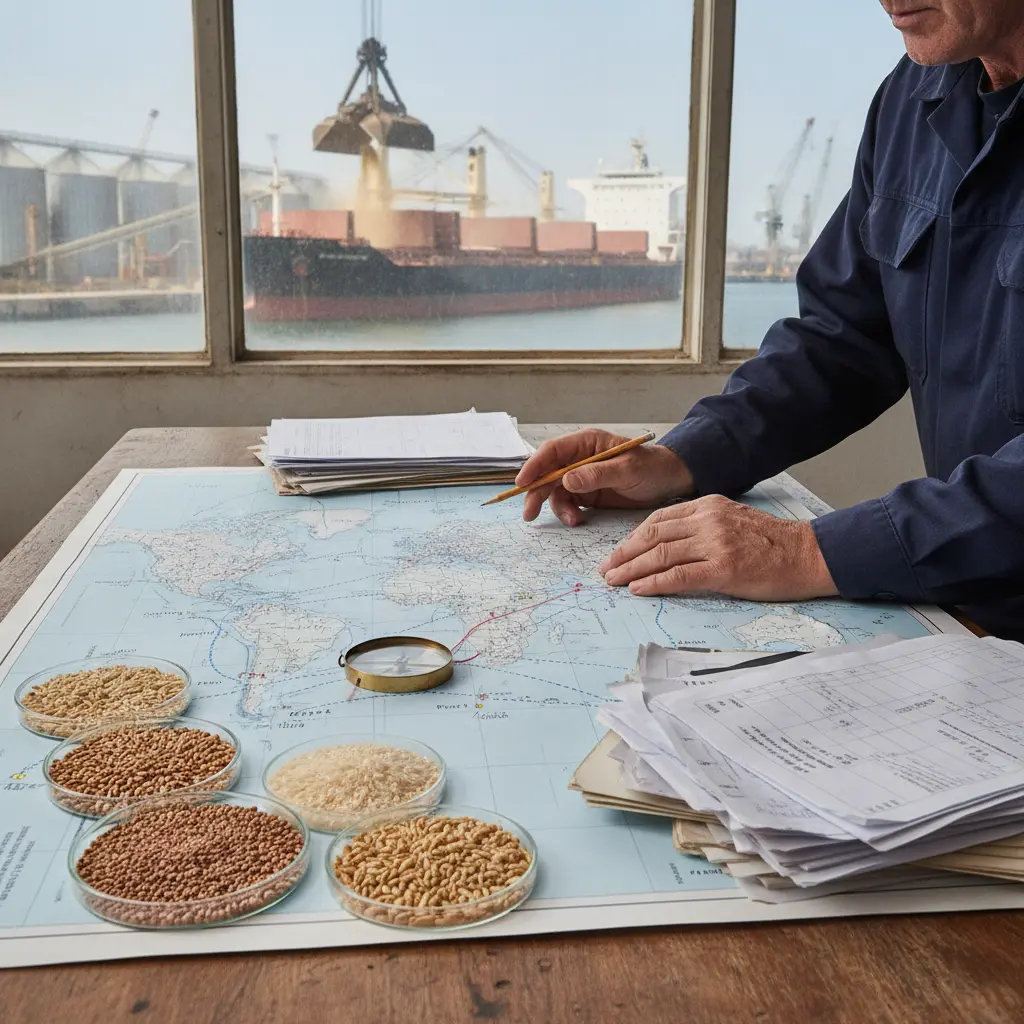
For dense bulk commodities like iron ore or mineral concentrates, deadweight capacity and permissible draft at loading and discharging berths represent the binding constraints. For light, bulky cargoes such as agricultural grains, woodchips, or biomass, the vessel's grain or bale cubic capacity often constrains intake before deadweight is reached. Desks must cross-examine the stowage factor against vessel hold dimensions to ensure the nominated parcel size fits within available cubic volume.
Terminal-specific requirements must also be screened manually or against recorded vessel particulars. These include crane safe working loads, outreach, grab availability for self-discharging operations, and vessel age limits imposed by terminal operators or cargo underwriters.

Reviewing and Filtering Matched Vessel Candidates
- 01
Filter matching pool by laycan feasibility
Screen open tonnage positions whose reported open dates and locations allow arrival within the cargo laydays-canceling window.
- 02
Apply technical and dimensional filters
Exclude candidates that exceed maximum draft, length overall (LOA), beam, or lack required gear configurations.
- 03
Review parsed offer confidence and review state
Inspect the review state and confidence score of parsed vessel positions to confirm data integrity before shortlisting.
- 04
Check source email lineage
Open the underlying source email text associated with the vessel offer to verify commercial caveats, exclusions, or commission terms.
- 05
Identify representation and overlapping circulars
Check whether the same vessel name or IMO has been circulated by multiple broker contacts to confirm representation lines.
- 06
Compile shortlist for commercial evaluation
Move qualified candidates to a working shortlist for formal freight negotiations and voyage calculation.
Managing Low Confidence Extractions and Incomplete Data
Unstructured broker emails often contain shorthand notations, ambiguous dates such as 'prompt' or 'end month', missing vessel names, or incomplete port descriptions. Automated email parsers tag extracted records with confidence scores and review states based on ambiguity in the source text.
When a cargo requirement or vessel offer is marked with low confidence or requires review, operators must inspect the raw text preserved in the offer record. Ambiguous dates should be resolved against the email header date, and non-standard geographic descriptions (such as regional trading ranges) should be verified. Maintaining explicit review states prevents unverified assumptions from propagating into matching lists.
Operational Boundaries: Automated Parsing vs Chartering Desk
| Workflow Domain | Automated Ingestion & Matching Engine | Chartering Desk & Broking Operations |
|---|---|---|
| Data Extraction | Parses cargo parameters, ports, dates, and tonnage from email | Reviews low-confidence extractions and confirms ambiguous terms |
| Candidate Screening | Filters database records across laycan, capacity, and region | Evaluates commercial counterparty risk and owner reputation |
| Voyage Feasibility | Identifies temporal alignment and geographic proximity | Calculates exact ETAs, canal transit delays, and weather allowances |
| Commercial Valuation | Presents structured matching offer records | Performs Voyage Estimation, TCE calculations, and bid-ask negotiations |
| Contract Execution | Maintains record history and source email lineage | Drafts charter parties, manages fixture recap, and executes contracts |
Handling Multiple Offers and Source Lineage
Market circulars routinely bundle multiple cargo requirements or vessel positions within a single email. Effective parsing must isolate distinct items, generating individual cargo or vessel offer records from one source document while preserving the original email text, timestamp, and sender identity.
Preserving source lineage is critical when evaluating candidate matches. When a desk selects an open vessel candidate, having immediate access to the originating broker email allows the operator to verify commission structures, specific owner exclusions, or private cargo terms that may not fit neatly into standardized database fields. This traceability ensures accountability across the chartering desk.
LaycanMatch Capabilities and Workflow Setup
LaycanMatch supports dual matching directions: matching available vessels for an active cargo requirement (vessel-for-cargo), and identifying open cargo orders for an available vessel position (cargo-for-vessel). The platform parses authorized broker email content into individual cargo and vessel offer records, with single circulars capable of generating multiple distinct offers.
Every parsed offer record retains its underlying raw text, sender information, extraction confidence level, and review state. New accounts receive a 1,000 processed-email free allowance to test ingestion and matching capabilities. In addition, the public parsing tool operates with zero input-text retention after delivering its extraction response, supporting privacy during preliminary evaluations.
By centralizing parsed records and maintaining explicit review workflows, chartering desks can systematically screen available market tonnage while keeping final commercial and operational validation firmly in human hands.